As the recycled plastics industry continues to develop, companies are paying increasing attention to recyclability, recycled content, and supply-chain traceability.
Two terms that often appear in this area are RecyClass and the Global Recycled Standard (GRS).
Although both are related to recycling and sustainability, they serve different purposes.
In simple terms:
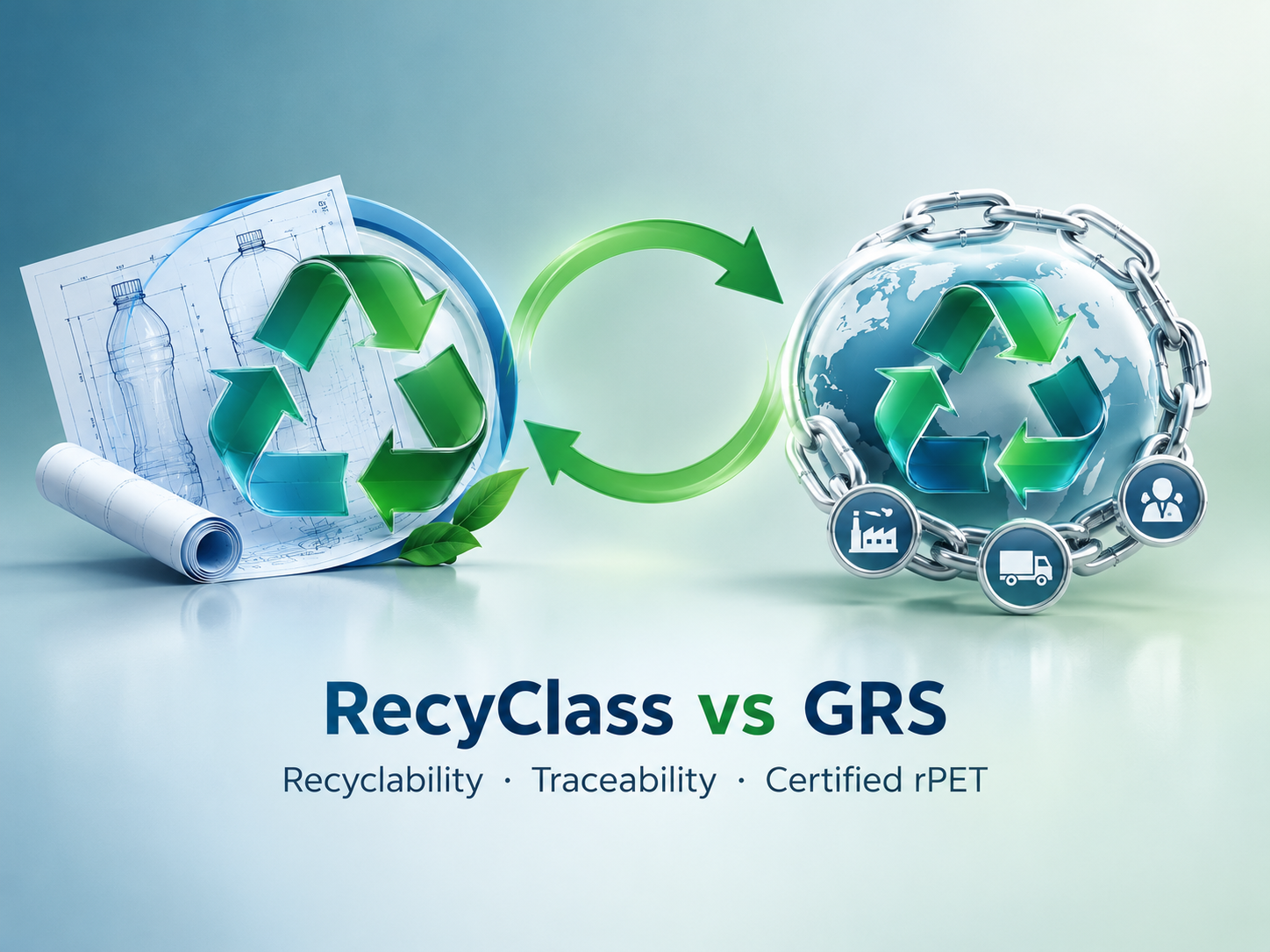
RecyClass focuses on recyclability.GRS focuses on recycled content and traceability.
Understanding the difference can help packaging manufacturers, recyclers, converters, brands, and recycled material buyers make better decisions.
What Is RecyClass?
RecyClass is an industry initiative focused on the recyclability of plastic products and packaging.
Its methodology evaluates whether packaging is compatible with existing collection, sorting, and recycling systems.
Factors that can affect packaging recyclability include:
- Packaging material
- Colors and additives
- Labels and sleeves
- Closures
- Adhesives
- Other packaging components
For PET packaging, for example, the design of the bottle and its different components can influence how effectively it can be collected, sorted, and recycled.
RecyClass provides Design for Recycling Guidelines, recyclability assessment tools, and certification schemes to help companies improve packaging design and recyclability.
RecyClass Online Tool vs. Certification
It is important to distinguish between the RecyClass Online Tool and formal RecyClass Certification.
The Online Tool provides a self-assessment of packaging recyclability and can help companies identify potential improvements in packaging design.
However, an Online Tool assessment is not the same as RecyClass Certification.
Formal RecyClass Certification involves an independent third-party assessment. Therefore, companies should not present an online assessment as an official RecyClass certification.
What Is GRS?
The Global Recycled Standard (GRS) is a certification standard developed by Textile Exchange for recycled materials and their supply chains.
GRS focuses on:
- Recycled content
- Chain of custody
- Traceability
- Social requirements
- Environmental requirements
- Chemical management
In other words, GRS helps verify recycled materials and track them through the relevant supply chain.
For companies purchasing recycled PET, this can provide additional assurance regarding the recycled content and traceability of the material.
RecyClass vs. GRS: What Is the Key Difference?
The simplest way to understand the difference is:
RecyClass → Can the packaging be effectively recycled?
GRS → Is the recycled material verified and traceable?
They are therefore complementary rather than interchangeable.
For example, a PET bottle may be designed according to recyclability principles, while the recycled PET produced after recycling may enter a certified recycled-material supply chain.
These two systems address different stages and aspects of the circular economy.
How Do RecyClass and GRS Relate to PPWR?
The EU Packaging and Packaging Waste Regulation (PPWR) is making packaging recyclability increasingly important for companies supplying the European market.
Under the PPWR, recyclability requirements will become progressively stricter from 2030, with additional requirements related to recycling at scale applying from 2035.
RecyClass can support companies in assessing and documenting packaging recyclability. However, RecyClass certification or an Online Tool assessment does not automatically mean that packaging is fully compliant with PPWR.
Companies remain responsible for meeting all applicable PPWR requirements and preparing the required technical documentation.
Why Does This Matter for rPET?
For rPET buyers, packaging recyclability and recycled material quality are related, but they are not the same thing.
The quality of rPET flakes can depend on factors such as:
- Intrinsic viscosity (IV)
- PVC content
- Moisture
- Color
- Purity
- Metal and other impurities
- Sorting and recycling processes
Therefore, when sourcing rPET, buyers should consider both material quality and traceability.
A certification does not replace the need to evaluate the actual technical specifications and suitability of the rPET material for the intended application.
Is GRS Still Relevant in 2026?
Yes. However, Textile Exchange is transitioning its standards framework toward the Materials Matter Standard.
The Materials Matter Standard was published in 2025 and becomes effective from December 31, 2026, with further transition requirements following in the coming years.
Companies planning long-term certification strategies should therefore monitor the latest Textile Exchange requirements and discuss the transition with their certification body.
Conclusion
RecyClass and GRS support different parts of the circular plastics value chain.
RecyClass focuses on packaging recyclability and Design for Recycling.
GRS focuses on recycled content, traceability, chain of custody, and responsible production requirements.
Meanwhile, PPWR is an EU regulation that establishes mandatory requirements for packaging placed on the European market.
For companies working with recycled plastics, understanding these differences can help improve packaging design, strengthen supply-chain transparency, and select the right recycled materials.
At RePlastic Global Materials, we supply rPET flakes for international buyers and manufacturers, with a focus on consistent quality, traceability, and reliable supply.
If you are sourcing rPET flakes for your production, feel free to contact our team to discuss your specifications and application requirements.