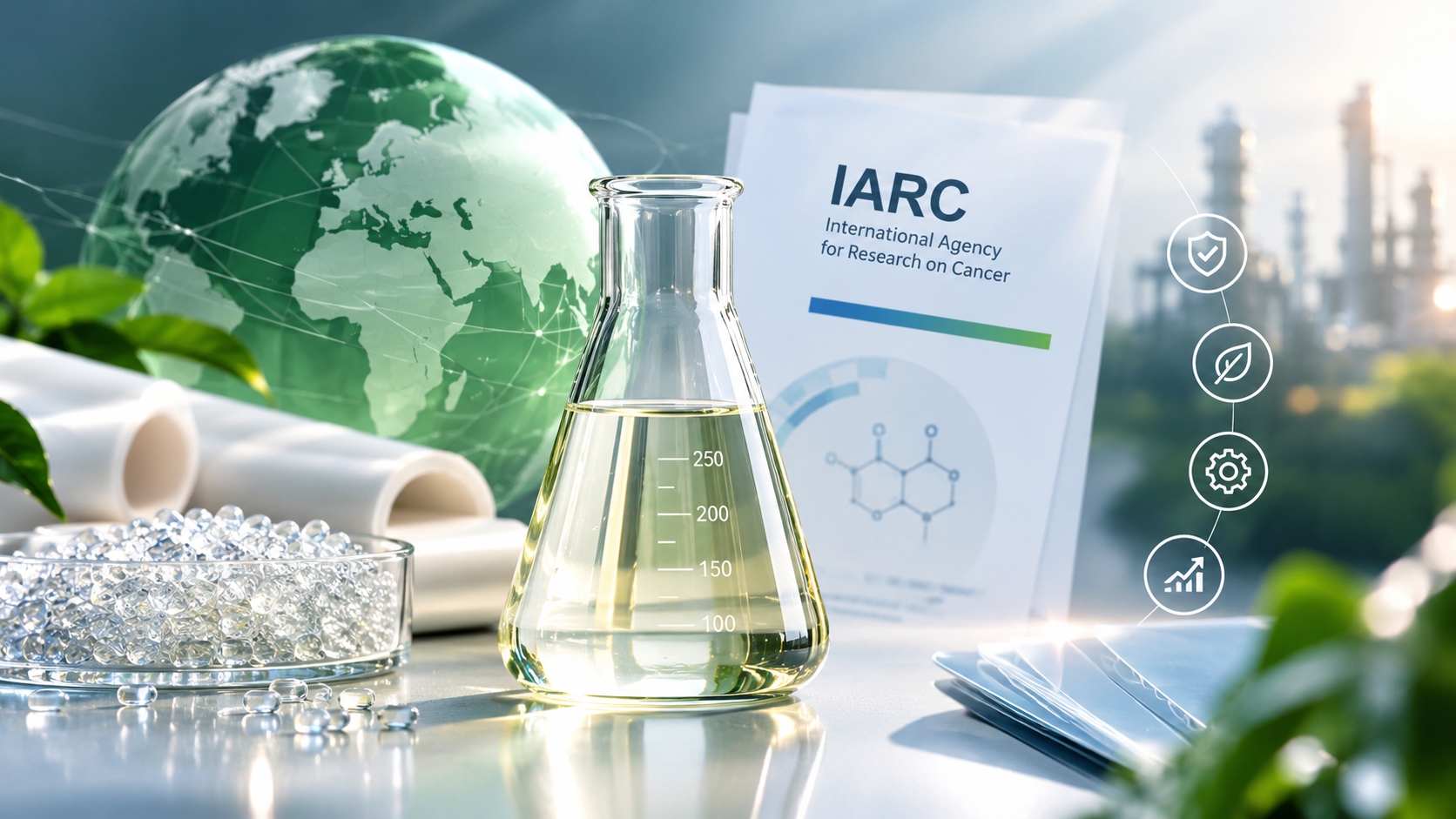
The International Agency for Research on Cancer (IARC) recently released updates regarding its Monograph Volume 142, covering three commonly used phthalate plasticizers: BBP (butyl benzyl phthalate), DBP (dibutyl phthalate), and DINP (diisononyl phthalate). The IARC working group classified all three substances as Group 2B (possibly carcinogenic to humans).
This news has drawn significant attention across the plasticizer and plastics recycling sectors. As a company specializing in global materials trading and compliant supply, Re-Plastic Global Materials Company wishes to take this opportunity to provide a clear, objective interpretation for our clients and partners.
I. What Exactly Does Group 2B Mean?
IARC’s classification system comprises four categories; Group 2B is the third category, determined based on “limited evidence in humans and/or inadequate evidence in experimental animals.” It ranks below Group 1 (carcinogenic to humans) and Group 2A (probably carcinogenic to humans).
It is crucial to emphasize that IARC’s classification assesses “hazard”—that is, whether a substance has the potential to cause cancer—rather than “risk,” which refers to the actual probability of cancer occurring at specific exposure levels. In other words, an IARC classification does not equate to a statement that “the substance poses a cancer risk under normal conditions of use.”
Furthermore, IARC assessments are not legally binding and do not directly alter the regulatory status of BBP, DBP, or DINP in the EU or other regions. Regulatory risk assessments and classification labeling continue to be conducted independently by national authorities in accordance with regulations such as REACH.
II. Key Scientific Details Regarding DINP
IARC noted that evidence of carcinogenicity in humans is inadequate for BBP, DBP, and DINP. Meanwhile, scientific and regulatory evaluations are considering whether the effects observed in laboratory animals are relevant to humans.
In the case of DINP, key tumor findings are linked to rodent-specific mechanisms that are generally considered not predictive of cancer risk in humans. This implies that while certain effects have been observed in animal studies, their actual significance for human health remains limited.
III. EU Regulatory Status: BBP and DBP Are Strictly Regulated; DINP Remains an Alternative
In the EU, BBP and DBP are classified as low-molecular-weight phthalates and are subject to strict regulatory controls. Conversely, DINP, a high-molecular-weight phthalate, is used in many applications as a substitute for low-molecular-weight phthalates.
DINP itself has been evaluated by relevant authorities based on extensive data under the REACH regulation. Under the UN GHS and EU CLP regulations, DINP is currently not classified under any hazard category.
IV. Impact on the Plastics Recycling and Materials Trade Industry
For companies like Re-Plastic Global Materials Company that specialize in global material supply, this IARC statement serves as a reminder that:
Compliance is the baseline; science is the foundation. We continuously monitor regulatory developments—such as EU REACH, US FDA, and China’s GB standards—to ensure that the materials we supply meet the compliance requirements of target markets.
DINP remains a key alternative. Given the strict controls on low-molecular-weight phthalates, DINP—as a high-molecular-weight alternative—continues to hold significant value in many non-food-contact applications.
Transparency is crucial. We are committed to providing our customers with accurate and timely information regarding material compliance, helping them make informed decisions in the global market.
V. Commitment from Re-Plastic Global Materials Company
As a participant in the global material supply chain, Re-Plastic Global Materials Company will continue to monitor IARC’s subsequent developments and maintain constructive dialogue with relevant stakeholders. We support the safe use of plasticizers and are dedicated to contributing to sustainable development goals in the EU and global markets.
If you have any questions regarding plasticizer compliance, material alternatives, or the global supply chain, please feel free to contact our technical team. We are ready to provide professional and reliable support.
About Re-Plastic Global Materials Company
We are a professional company specializing in the global trade of plastics and recycled materials, dedicated to providing our customers with compliant and sustainable material solutions. Our product portfolio spans various sectors—including rPET, plasticizers, and additives—serving customers worldwide.