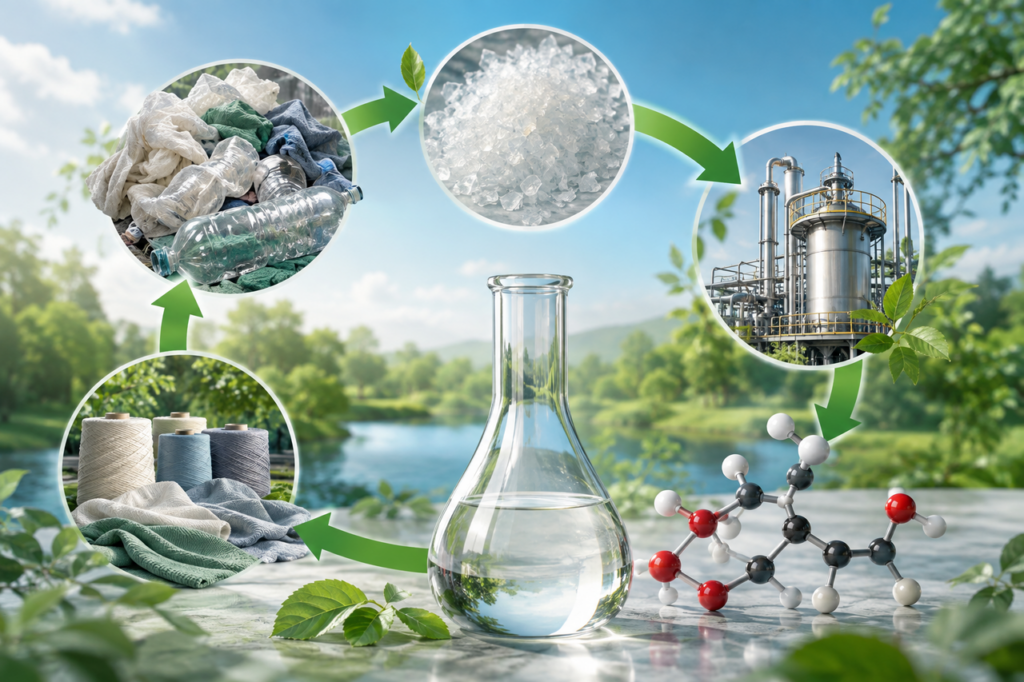
Every second, a volume of textiles equivalent to an entire garbage truck is sent to landfills or incinerators worldwide. Polyester accounts for a significant share of this massive waste stream—ranging from factory offcuts and discarded clothing to advertising banners and rope scraps. Most of these materials are derived from non-biodegradable fossil-based feedstocks; once discarded, they persist in the environment for a long time.
However, due to the lack of effective recycling systems, most of this polyester ultimately ends up in landfills or incinerators. The Ellen MacArthur Foundation has noted that the global economy loses up to $500 billion annually due to low clothing utilization rates and inadequate recycling.
The problem goes further. In the European Union, approximately 6.95 million tonnes of textile waste are generated annually—about 16 kilograms per person—yet only around 12% is recovered through separate collection systems. In China, the world’s largest textile producer, annual textile waste exceeds 20 million tonnes, with a recycling rate still below 30%. Unlike PET bottles, which benefit from mature collection systems, polyester textile waste comes from highly fragmented sources. It is often mixed in color, contains dyes and coatings, and is frequently blended with cotton or spandex—factors that have long hindered the development of effective recycling pathways.
Faced with this reality, we have chosen not to look away, but rather to redesign solutions starting at the source.
Why does mechanical recycling fall short?
While mechanical recycling (shredding and remelting) works reasonably well for clear PET bottles, it struggles to handle textiles effectively. Each melting cycle degrades the polymer chains; consequently, recycled polyester is often “downcycled” into low-value filling fibers, and the number of times it can be recycled is severely limited.
Even more challenging is the fact that textile polyester carries disperse dyes, water-repellent agents, and coatings, and is frequently blended with cotton or elastane. During the melting process, these impurities remain in the polymer, causing discoloration and a loss of strength. Mixed-color waste—such as purple, red, or black scraps—finds almost no viable outlet in traditional recycling processes.
Chemical recycling was developed specifically to break this deadlock.
Chemical Recycling: Transforming Waste Polyester into High-Purity DOTP
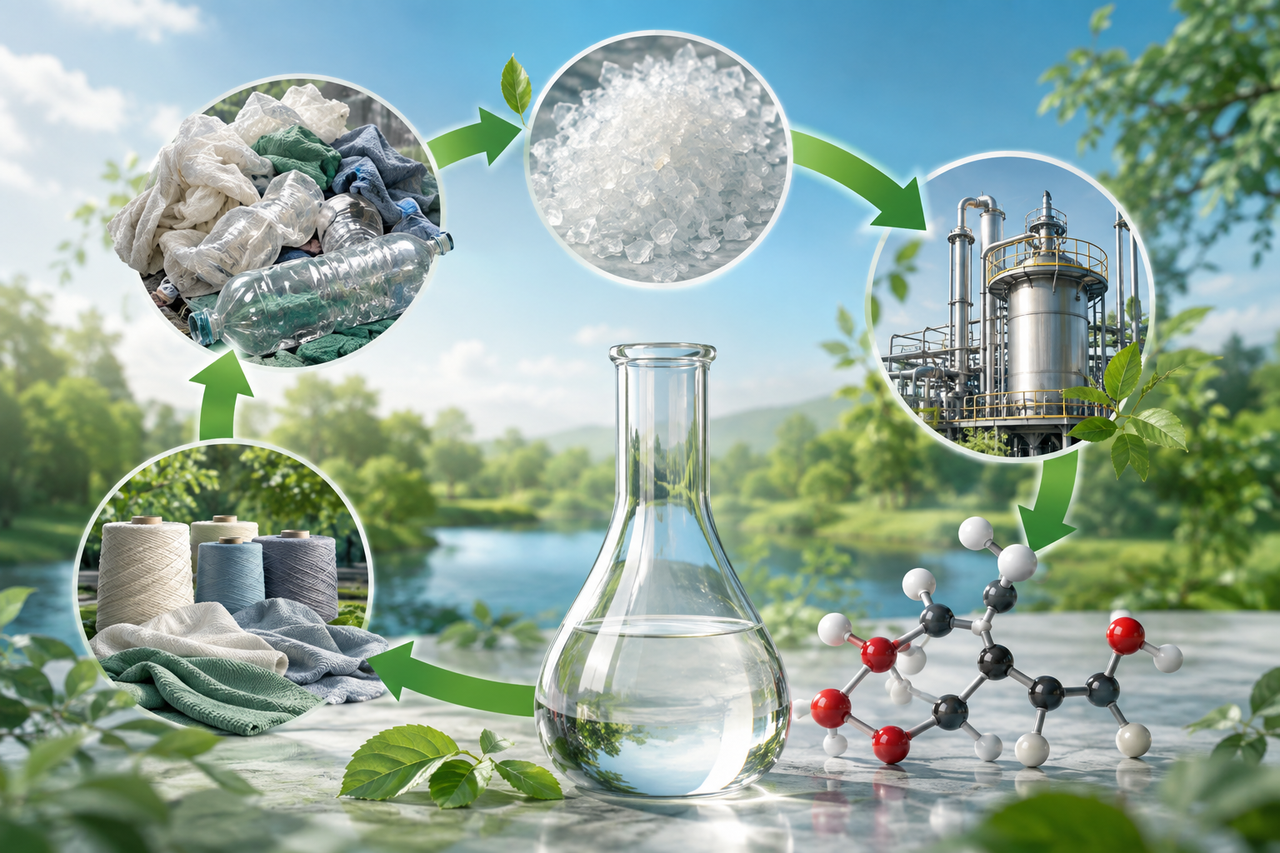
Our core technological approach utilizes a catalytic alcoholysis-transesterification process. Simply put, we break down the molecular chains of waste polyester and re-esterify them using octanol to synthesize a brand-new, high-purity molecule: DOTP (Dioctyl Terephthalate).
The specific process involves:
1.Sorting and Pre-treatment
Incoming raw materials are sorted based on polyester content; non-polyester accessories such as zippers and buttons are removed, and dyes and finishing agents are treated during the pre-treatment stage.
2.Depolymerization (Alcoholysis)
Under controlled temperature and pressure, a proprietary catalyst is used to break down long-chain PET into monomers and oligomers.
3.Octanol Transesterification
Intermediate products react with 2-octanol to form the DOTP ester structure.
4.Purification and Refining
Through multi-stage refining, we produce an eco-friendly DOTP that is colorless, high-purity, and meets virgin-grade quality standards.
5.By-product Recovery
Co-produced ethylene glycol is refined and returned to industrial use; the process is designed so that no materials become waste.
The carbon emissions from this catalytic PET-to-plasticizer process are approximately 40% lower than those of non-catalytic baseline methods, while also remaining economically viable.
Beyond Environmental Protection: The Tangible Value We Create
Choosing DOTP made from waste polyester delivers a range of quantifiable sustainability benefits:
1.Significant Carbon Footprint Reduction
By utilizing the terephthalate structures already present in textiles to replace virgin petroleum-based feedstocks, we reduce the extraction of fossil resources at the source.
2.Large-Scale Waste Conversion
Our facility, which processes 150,000 tons of recycled raw materials annually, diverts tens of thousands of tons of polyester textiles from landfills or incineration each year.
3.Full Utilization of By-products
Co-produced ethylene glycol is purified and supplied to downstream industries, truly realizing a “zero-waste” design philosophy.
4.Safe and Phthalate-Free
DOTP is a non-phthalate plasticizer, making it suitable for sensitive applications such as toys, household gloves, wires and cables, and food-contact materials.
We are Doing Far More Than Just Recycling
At Re-Plastic Global Materials, we have built more than a mere production line; we have established a comprehensive network spanning collection, sorting, and chemical transformation, all the way to end-product application. Every batch of colored offcuts, every discarded garment, and every scrap of waste advertising banner entering our facility is transformed within our system into high-quality raw materials ready to re-enter the industrial cycle.
This is not a mere laboratory concept, but a reality unfolding every day.
We believe that discarded polyester should not mark the end of the road, but rather the beginning of a new cycle. If you are seeking a reliable, traceable, and quantifiable pathway to sustainable materials, we invite you to join us on this journey.